

ENFORCE Research Explores the Role of Citizen Science in Forest Protection
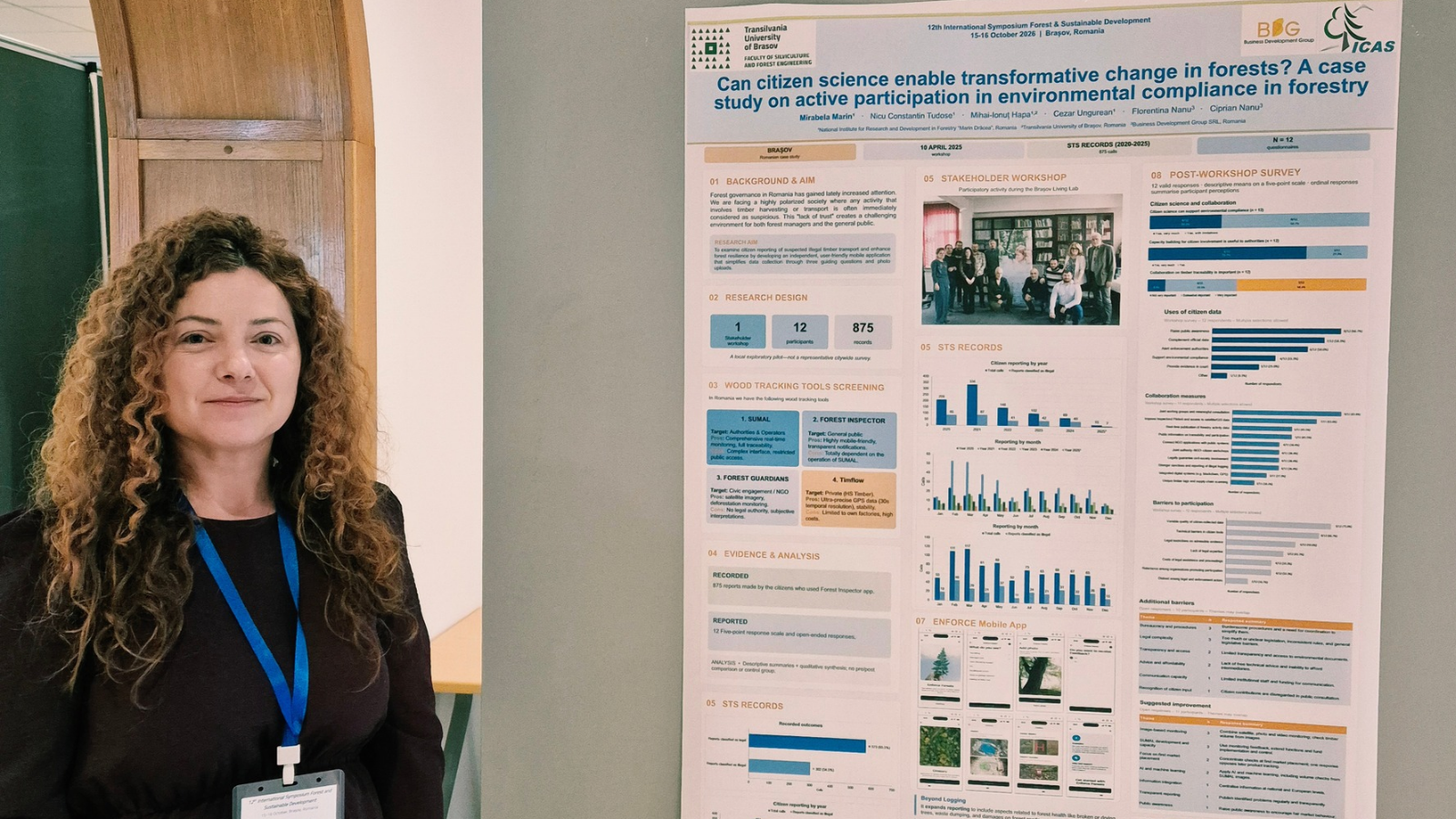
How can citizen participation support forest protection and environmental compliance? A case study in Brașov, Romania, explores the potential of citizen science to strengthen forest monitoring and accountability.
Researchers contributing to the EU-funded ENFORCE project presented their research at the 12th Biennial International Symposium on Forest and Sustainable Development, held on 15–16 October 2026 in Brașov, Romania.
The study, Can citizen science enable transformative change in forests? A case study on active participation in environmental compliance in forestry, examines how accessible reporting tools and greater public participation can contribute to sustainable forest management.
Making forest monitoring accessible
Romania’s forests cover 29.3% of the country’s territory and are essential for biodiversity, ecosystem services and climate mitigation. However, protecting these ecosystems requires effective monitoring and collaboration between citizens, forest managers and public authorities.
As part of the ENFORCE case study in Brașov, the research team is developing an independent, user-friendly mobile application to facilitate public reporting of potential forest-related incidents. The application will guide users through three questions and allow them to upload photographs of their observations.
Reports will be shared with local forest managers for field verification, helping determine whether observed incidents result from natural processes, authorised forestry operations or potentially illegal interventions.
The initiative aims to make participation in forest monitoring more accessible while strengthening the connection between citizen observations and institutional follow-up.
Building environmental awareness and accountability
Alongside the mobile application, the team is developing an illustrated glossary of key forestry and environmental terms to improve public understanding and help citizens engage more confidently in forest protection.
The study also highlights the importance of local accountability, effective enforcement, communication between stakeholders and support for forest owners. These elements are essential to ensuring that citizen-generated information can contribute to meaningful environmental action.
By combining accessible reporting tools with public environmental education and field verification, the Brașov case study explores how citizen science can support more transparent and participatory approaches to forest governance.
The research contributes to ENFORCE’s broader work on strengthening environmental compliance through citizen participation and improved collaboration between communities and the authorities responsible for environmental protection.
Read the poster
Read the abstract
Research team: Mirabela Marin, Tudose Nicu Constantin, Ionut Mihai Hapa and Cezar Ungurean (National Institute for Research and Development in Forestry “Marin Drăcea”); Florentina Nanu and Ciprian Nanu (Business Development Group SRL), Romania


