

When citizens report, who responds? ENFORCE webinar explores civic evidence in environmental compliance
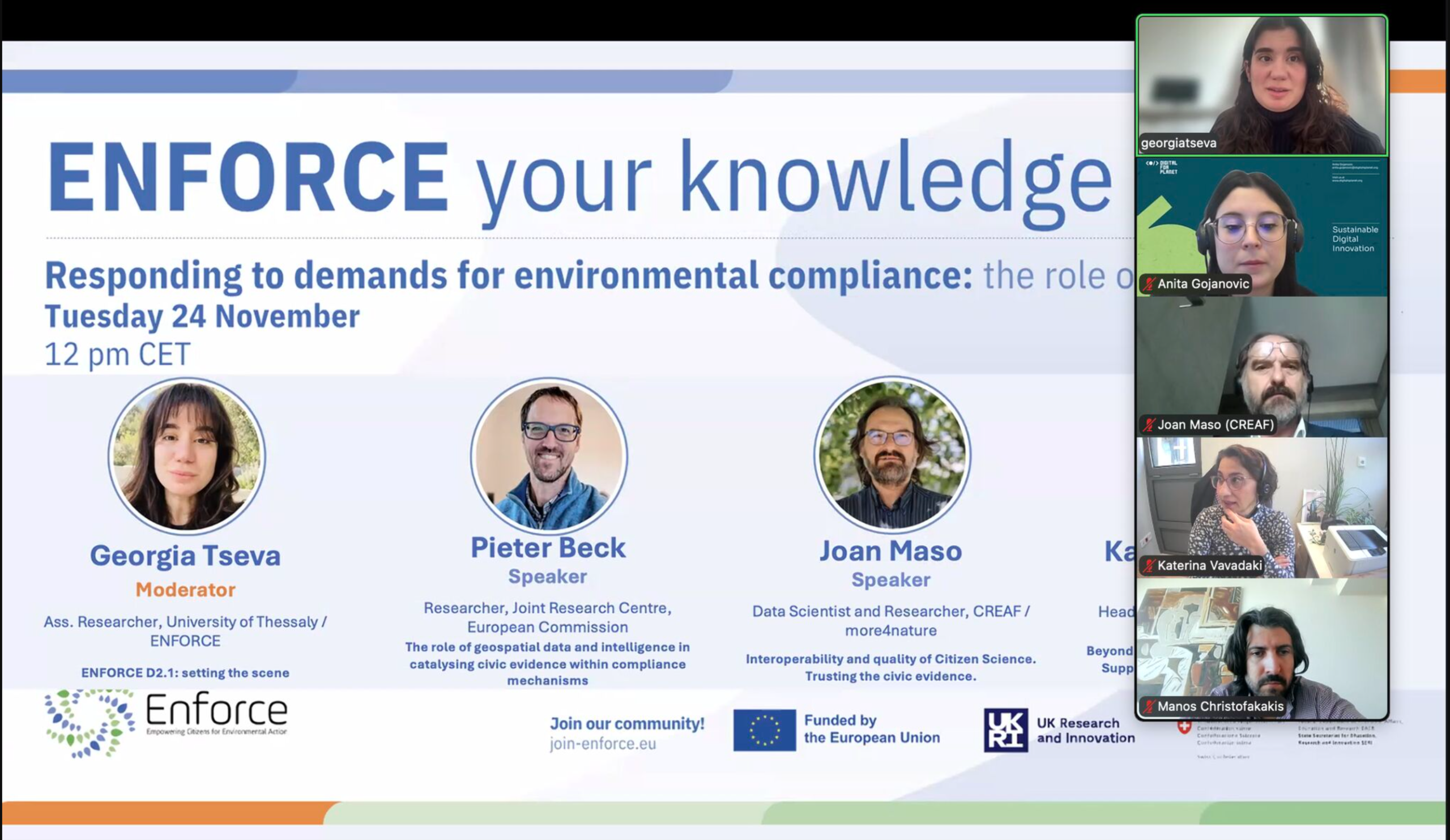
Citizens can flag environmental problems early, but their reports are more likely to lead to action when good data meets clear procedures at the authorities receiving them. This was the central theme of the ENFORCE webinar Responding to demands for environmental compliance: the role of civic evidence, held online on 24 November 2026.
“People report incidents but hear nothing back”
Moderator Georgia Tseva (University of Thessaly) opened with this statement, voiced by an environmental authority interviewed by ENFORCE. She presented the project’s first research findings, based on a survey of 169 stakeholders and around 40 interviews. Respondents broadly see citizen data as a useful addition to official data, but are unsure how to use it in formal procedures. The main barriers are institutional distrust, data quality concerns, and gaps in laws and procedures. Authorities value early warnings but ask for checked data, clear locations and agreed procedures. The conclusion: better data and clear authority procedures must go together, including feedback to citizens.
From satellites to inspections: insights from the speakers
Pieter Beck, researcher at the European Commission’s Joint Research Centre, showed how commercial satellites now deliver near-daily, metre-level images that can track activities on the ground, not just monitor resources. Drones are increasingly accessible to citizens and civil society, and drone footage can bridge the gap between what happens on the ground and what satellite maps show. He pointed to the JRC report Earth Observation in Support of Compliance Assurance across EU Policies. He also highlighted the IMPEL GIECA project, which works with inspectors, prosecutors and judges to set standard procedures for using geospatial data as evidence.
Joan Masó, data scientist and researcher at CREAF, presented the Horizon Europe project more4nature, ENFORCE’s sister project. To break down citizen science data silos, he argued for open standards and open protocols rather than a single data lake. He also called for common vocabularies so that projects mean the same thing when they describe what they observe. He presented STAplus, an extension of the SensorThings API standard that adds the citizen making the measurement. He highlighted automatic alerts on anomalous values as particularly relevant for compliance assurance. Data quality, he stressed, must be considered throughout: when planning a project, collecting data, analysing it and managing it.
Katerina Vavadaki, Environmental Engineer, Head of the Department of Environment, Heraklion Regional Unit, Directorate of Environment and Spatial Planning (Region of Crete), explained that citizen complaints are a key trigger for inspections, but each is assessed first. She urged citizens to report specific observations with location, date and photos. Authorities, in turn, should set standard procedures, preserve evidence quality during referrals, cooperate more closely, and tell citizens what happened to their complaints.
“The challenge is not only to collect more information,” Katerina concluded, “but to ensure that the information can be properly assessed and translated into appropriate environmental action.”
In her closing remarks, Georgia Tseva highlighted how the contributions helped answer the question at the heart of the session: how to better support citizens in reporting environmental problems.


